
Industry trends for AI
The military has a saying: “Slow is smooth, and smooth is fast”. But with all the hype around AI in the tech industry, we have to ask ourselves, do we really believe that?
Microsoft recently shared that around 35% of their code for new products is now AI generated, with a general savings of over $500 million across tech and call center departments.
Embedded post on x.comhttps://x.com/marketsday/status/1944030987874447886
That is substantial, and signals to the larger tech industry that AI will make your greenfield development faster. There’s no doubt, and we have proven this ourselves at SkillRev on multiple projects already.
But we have to burst the bubble and say that we didn’t get there vibe coding!
What Is a ✨ Vibe-Coded ✨ Project?
“Vibe coding” happens when a team or individual builds based on intuition, inspiration, or short-term deliverables—without clear specs, documentation, or architectural planning. It’s common in early-stage startups or innovation teams where speed is emphasized, but it can backfire:
- No source of truth for why things were built a certain way
- Inconsistent or unreviewed code that’s hard to onboard new devs into
- Tech debt disguised as MVPs
- Low confidence in feature readiness, test coverage, or scalability
These issues don’t show up on a Jira board—but they show up in burnouts, bugs, broken trust, or a general lack of speed in month 2 and beyond.
In fact, some senior software engineers find themselves in a position to help teams dig out of a crisis - if they think they can do it without losing morale!
Embedded post on x.comhttps://x.com/jasonlk/status/1945925511680537002
Should I vibe code?
Yes and no. There’s a growing reaction against this phrase in software, and rightfully so. We’re learning that AI models are the most productive when you give them:
- Smaller tasks (break down your project, just like you would for developers)
- Lots of context (just like a real software engineer, knowing the business “why” that surrounds your features matters a lot)
- Agentic orchestration (a great article to demistify the core of how this works is here at Amp Code)
So really this is less about “vibe coding” and more about having good project hygiene, clear specs, and ensuring your LLM has all of this information in context as it generates a solution for you.
You should try Context Engineering
As it turns out, giving AI the right context is hard. Generalist tools like Cursor, Devin, or Factory AI are trying to do this, and those tools are pretty good at general well understood problems (i.e. “build me a Dropbox clone”).
However, your organization exists because it’s unique, niched, and doing something no other business does as well as you do. So how can you make an agent that adopts your culture, style, best practices, engineering standards, and actually “gets” your proprietary requirements?
Let us bootstrap your AI adoption 🚀
At SkillRev, we are getting really good at building customized agents that have a high percentage of success for your tasks. Combined with the guidance of your engineering team, these tools will put a dent in your product work and de-risk your product launch. We see a bright future, where AI is just another tool that engineers adopt amidst a culture of mentorship, code review, and software craftsmanship.
In fact, we’ve discovered that there are a few similarities between the kinds of problems solved with AI agent adoption and those that an organization has to overcome when augmenting their engineering group with offshore developers. We’ve helped several organization fix bad offshore culture, where developers lacked context, were not given permission to lean into business requirements, or just had low accountability and then got exploited by some agencies.
As we process our own adoption of AI in our consultancy, we enthusiastically embrace a future where AI, offshore, and onshore all have roles to play as clearly as frontend and backend do in your tech stack!
Our 5-year Future-of-Work Prediction
We’re heading towards a world where humans and machines work side-by-side, of course. Based on our own implementation experiences, we would argue that this world broadly has three types of workers:
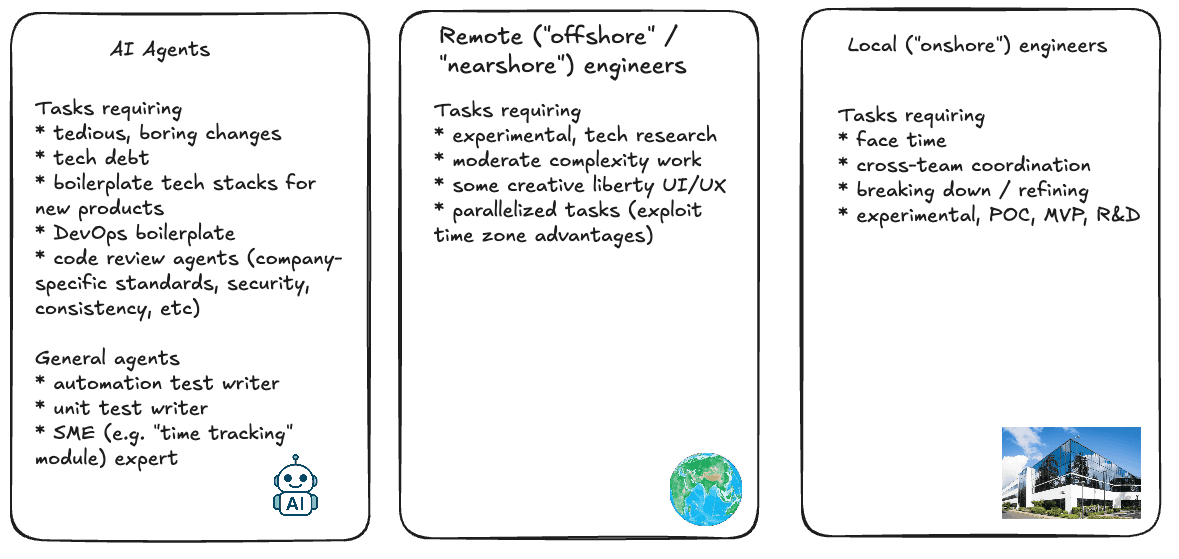
Now, teams get to “shift left” the tedium to maximize cost savings, and “shift right” the interesting, human-dignifying work.
Are you ready?
Is your organization ready to reap the benefits of staff augentation with both humans and machines? Reach out for a no obligation consult to see what could be improved!